Showing posts with label news. Show all posts

Adopting Ubuntu - Linux switch can be painless, free

March 23, 2007
By David Conabree

The author is a regular reviewer of new high-tech gear and longtime computer user.

In all the "switcher" TV ads that the folks in Apple's marketing department have come up with, the choice is always the same. Go with the clunky and complicated Microsoft Windows machine, or pick up the hip and sleek designer Apple computer running the Mac OS (hip and sleek short form for "operating system"). They're good ads — heck, I've even gone to Apple's website just to watch them.

But there is another choice out there that a lot of people simply aren't aware of because there's no slick marketing campaign behind it.

For many people, e-mail, web surfing, picture editing, listening to music, making spreadsheets and basic word processing are just about all they do with their computers. Today's Macs and Windows PCs are impressive machines indeed, but their power — and price — can be overkill for the average computer user. If you're looking for a new computer and you're not sure whether to go Windows or Mac, I'd suggest also paying some attention to the "L" word.

No, not that "L" word. I'm talking about Linux.
A brief history of Linux

For those of you not familiar with the world of Linux, let me give you the Coles Notes version. Some time ago, a rather creative software engineer in Finland decided he wanted to build a new computer operating system in his spare time. In what ended up earning him a near god-like status in the "geek" hierarchy, Linus Torvalds and a growing group of volunteers eventually did the highly improbable, putting together a new kind of operating system that could go head to head with the software that companies like Microsoft and Apple have spent millions developing.

Torvalds then went and gave his software, called Linux, away to anyone who wanted to use it or tinker with it, so long as they agreed to openly share any changes or improvements they made. Since that time, dozens of flavours of the Linux operating systems have come out, and the majority of them are utterly free. They're also stable, secure, easy to use, and generally not plagued by spyware and viruses the way commercial operating systems are.

Now, back to our story.
Ubuntu

Linux, and more specifically the free "Ubuntu" version, has come a long way in the past few years and is well worth considering for basic computing.

Best of all, it won't cost you a penny to try it out.

Like many Linux distributions, the entire Ubuntu operating system is available as a free "Live CD" you can download from the internet. Just burn the file [called an "ISO"] to a CD, and that's it ... you're ready to try Ubuntu on any home or business PC. Alternatively, you can pay a small shipping fee and have an Ubuntu disc delivered to you by mail.

Either way, reboot your Windows machine with the disc in the CD drive, and rather than starting up Windows, the computer will run Ubuntu directly from the CD. This means that your entire Windows installation, including all of your personal files, are left entirely untouched — nothing is "installed" over the existing content on your machine. Once you're finished trying Ubuntu, just take the CD out, reboot and your PC will start Windows exactly as it did before.

So what is it like?

Amazingly, Ubuntu feels much like Windows. I have converted several friends to Ubuntu over the years and every one of them has had the same opinion — everything is where you think it should be if you're familiar with a Windows computer.
Software

The Linux operating system comes with great open-source software, and the icons for them are right there on your desktop where you'd expect to find them. Want to write a memo? Ubuntu comes with Open Office, a full (and free) office software suite that works with Microsoft documents, such as spreadsheets, text files and presentations. For browsing the internet, you get Firefox, the same browser I use now for both my Windows and Mac machines. Play music in the Rhythmbox Media Player or play your videos in Totem — again, both included for free.

With the exception of gaming, which is limited, almost all of the average person's basic computing needs are well looked after with this package. I've used the last three versions of Ubuntu on my main portable web-surfing computer for years just to avoid viruses and spyware (as the vast majority of these nasty programs are written for Windows), and I have yet to be disappointed.

With the exception of gaming, which is very limited, almost all of the average person's basic computing needs are well looked after with this package.

If you like it, you can load Linux permanently onto a cheap "bare bones" PC from your local computer store, saving yourself a chunk of cash that you'd otherwise have to spend on an operating system, software and high-powered hardware. The Ubuntu software is free, although there is an option where you can buy several years' worth of support and troubleshooting if you feel you'll need some extra help.

I've also "resurrected" several old machines using Ubuntu and various other versions of Linux that are far more compact and less memory intensive than Windows or the Mac OS, so they don't need as much computing power to run them. It's amazing to see how quickly you can breathe new life into an old beige-box geezer and save it from the landfill, rather than junk it because it doesn't have the power to keep up with the latest commercial operating system.

The "Damn Small Linux" version actually comes in at a paltry 50MB for the entire operating system, complete with basic software to cover most daily computing needs — it's great for getting more use out of old desktops or notebooks.

Ubuntu, however, is far slicker and more powerful than these trimmed-down versions of Linux. If you're new to the Linux world and want to compare the experience to Windows or the Mac OS, I highly recommend Ubuntu as the best place to start. It will cost you nothing to try out, and you might just be surprised at how good "free" really is.


Source

The French Parliament switches to Ubuntu

The French Parliament looks to be the next big Ubuntu switcher according to reports. Recently the Parliament produced an official government report that recommended the use of free software over proprietary software. The switch to free software is expected to provide a substantial savings to the tax-payers according to the government study.

Following this recommendation two companies, Linagora and Unilog, have been selected to provide the members of the Parliament as well as their assistants new computers containing free software. This will amount to 1,154 new computers running Ubuntu prior to the start of the next session which occurs in June 2007.

More detailed information can be read in French at ZDNet.fr and latribune.fr. There is also an article available in English from November 2006 pertaining to this same exact report at ZDNet.com.


Source: http://fridge.ubuntu.com/node/814

Ya ubuntu!

Farmer's confession to undercover cop on murders

KILLED 49 WOMEN AND FED THEM TO MY PIGS

Farmer's confession to undercover cop on murders
By Ryan Parry And Vanessa Allen

A PIG farmer accused of being Canada's worst serial killer confessed to killing 49 women, a court heard yesterday.

Robert Pickton allegedly told an undercover police officer: "I was going to do one more, to make it an even 50."

Pickton, 56, is said to have picked up the women, mostly prostitutes and drug addicts, from Vancouver's red light district.

He is alleged to have taken them back to his remote 17-acre farm, where he butchered them.

He is then said to have put their bodies through an industrial woodchipper and fed their mince to his pigs, some of which were later slaughtered and sold into the human food chain.

Jurors were warned that details of the crimes would be "like a horror movie" and relatives of the victims began to cry as the case was opened.

The court heard that a police interviewer had suggested he was caught because he hadn't cleaned up blood properly. He is said to have replied: "I was going to shut it down. That's when I was just sloppy. Just the last one."

...

Original Source: http://www.mirror.co.uk/news/tm_headline=i-killed-49-women-and-fed-them-to-my-pigs-&method=full&objectid=18516513&siteid=94762-name_page.html

Having just read The Innocent Man 978-0-385-51723-2 (0-385-51723-8) I find that they are using a confession to undercover cop as evidence a bit creepy.

IBM Breaks Patent Record, Wants Reform

"IBM set the record for most patents granted in a year for 2006. At the same time, IBM points out that small companies earn more patents per capita than larger enterprises and pushes for reform to address shortcomings in the process of patenting business methods: 'The prevalence of patent applications that are of low quality or poorly written have led to backlogs of historic proportions, and the granting of patents protecting ideas that are not new, are overly broad, or obvious.' And the company has been committing itself to a new patent policy: 'Key tenets of the policy are that patent quality is the responsibility of the applicant; that patent applications should be open to public examination and that patent ownership should be transparent; and that business methods without technical content should not be patentable.'"

Source: http://yro.slashdot.org/article.pl?sid=07/01/11/2134221&from=rss

UK in plastic electronics drive

UK firm Plastic Logic has said it will build the world's first factory to produce plastic electronic devices.

The Cambridge-based company has secured $100m (£50.6m) venture capital funding for the German plant.

Once built it will manufacture circuits crucial for the development of novel gadgets such as electronic paper.

Unlike silicon, plastic circuits can be made using simple printing techniques and could dramatically reduce the price of consumer electronic goods.

The factory will be built in Dresden, known for its strength in silicon technology.

Plastic spin-out

Plastic Logic is a spin out from Cambridge University and has been developing plastic electronic devices since 2000.

The firm is working on "control circuits" that sit behind screens on electronic displays. In particular, it is working on the electronic circuitry for "electronic paper" displays.

These flexible devices can store the text of thousands of books or newspapers and could one day replace paper.

Industry experts forecast the market for plastic electronics could be worth $30billion by 2015.

When it is built in 2008, the new factory could produce one million control circuits in a market that is tipped to expand to 41.6 million units in 2010.

The factory will be backed by funding from Oak Investment Partners and Tudor Investment.


Source: http://news.bbc.co.uk/2/hi/business/6227575.stm

Google Blatantly Copies Yahoo!?

I'm not sure if this is stupidity, laziness, or a mix of both, but check this out.

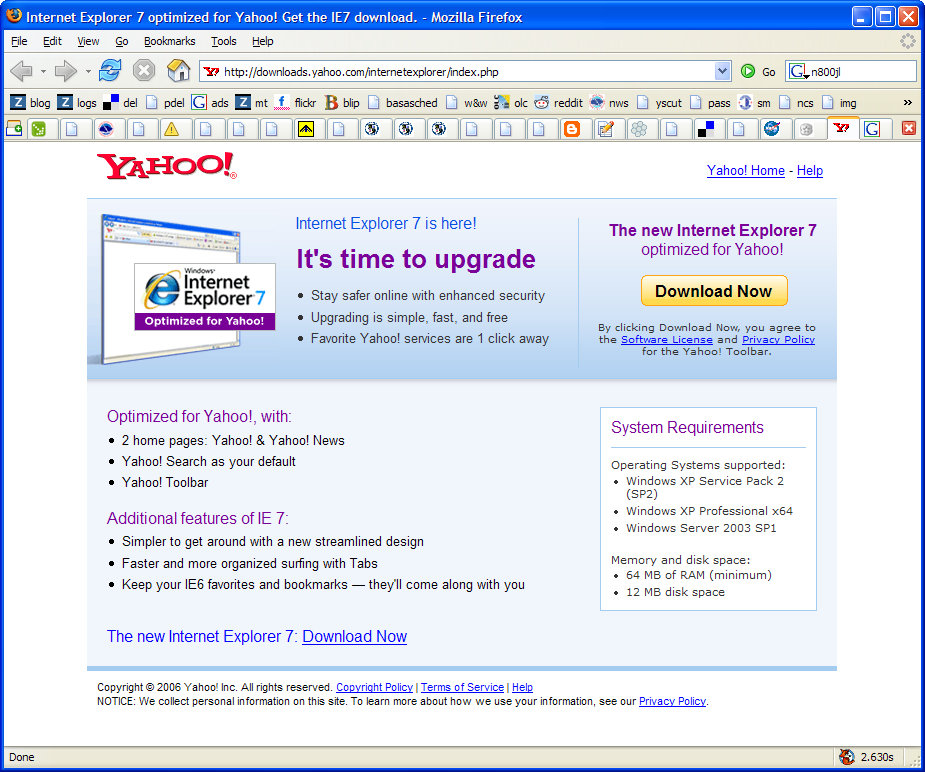
Back when IE7 launched, Yahoo! created a customized version and began to market it

to our existing IE users. The "splash page" looked like this:

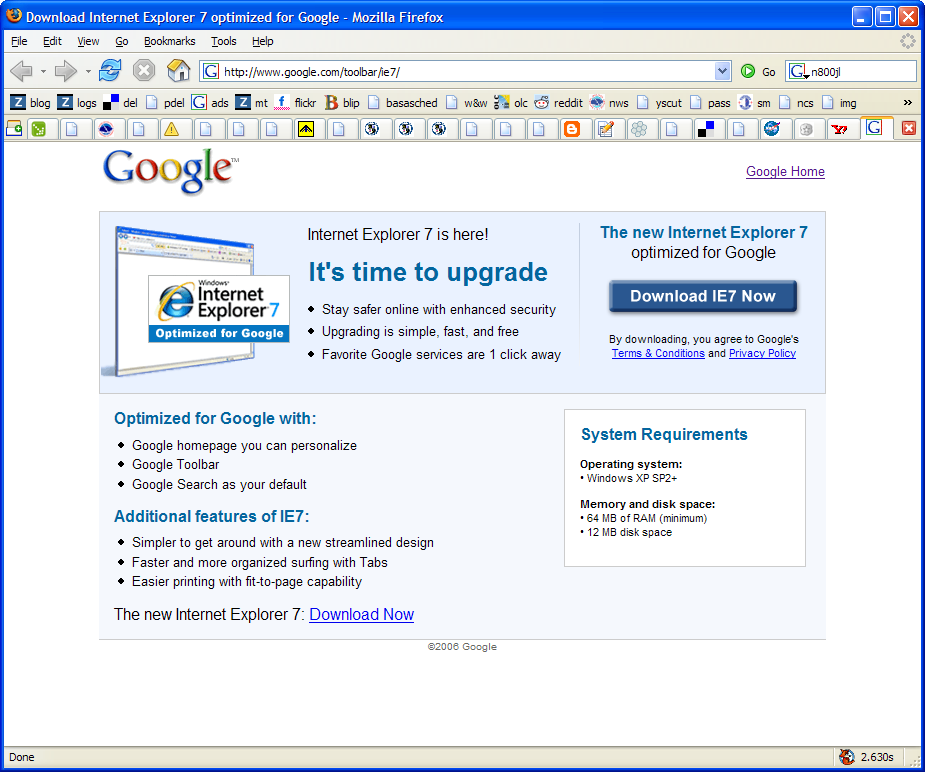
Today it seems that Google has similar intentions. So similar, that they decided to basically copy our page and slightly Googlify it. If you look, the design, layout, and most of the text are the same!

WTF is that about?

Was some product marketing person so uninspired that he or she decided it was "good enough" to just copy us?

Seriously, click those images and look at the full-sized versions. They're remarkably similar. And I've checked with our PR group to make sure that this was just a template that Microsoft gave to all partners. It's not.

Yikes. Even the toolbar in the Google version of the picture has bits of Yahoo still in it.

Source: http://jeremy.zawodny.com/blog/archives/008122.html

Can this really be true, If it is shame on google :(

Edit: well I did more digging and this is the original image from the google site found at http://www.google.com/toolbar/ie7/getie7.gif

Now check out the zoomed in version of that image

Still not convinced look at this

Now all we need to check is that yahoos site came fist.

Yup a very sad day for google

Seeking Iran Intelligence, U.S. Tries Google

When the State Department recently asked the CIA for names of Iranians who could be sanctioned for their involvement in a clandestine nuclear weapons program, the agency refused, citing a large workload and a desire to protect its sources and tradecraft.

Frustrated, the State Department assigned a junior Foreign Service officer to find the names another way -- by using Google. Those with the most hits under search terms such as "Iran and nuclear," three officials said, became targets for international rebuke Friday when a sanctions resolution circulated at the United Nations.

Policymakers and intelligence officials have always struggled when it comes to deciding how and when to disclose secret information, such as names of Iranians with suspected ties to nuclear weapons. In some internal debates, policymakers win out and intelligence is made public to further political or diplomatic goals. In other cases, such as this one, the intelligence community successfully argues that protecting information outweighs the desires of some to share it with the world.

But that argument can also put the U.S. government in the awkward position of relying, in part, on an Internet search to select targets for international sanctions.

None of the 12 Iranians that the State Department eventually singled out for potential bans on international travel and business dealings is believed by the CIA to be directly connected to Iran's most suspicious nuclear activities.

"There is nothing that proves involvement in a clandestine weapons program, and there is very little out there at all that even connects people to a clandestine weapons program," said one official familiar with the intelligence on Iran. Like others interviewed for this story, the official insisted on anonymity when discussing the use of intelligence.

What little information there is has been guarded at CIA headquarters. The agency declined to discuss the case in detail, but a senior intelligence official said: "There were several factors that made it a complicated and time-consuming request, not the least of which were well-founded concerns" about revealing the way the CIA gathers intelligence on Iran.

That may be why the junior State Department officer, who has been with the nonproliferation bureau for only a few months, was put in front of a computer.

An initial Internet search yielded over 100 names, including dozens of Iranian diplomats who have publicly defended their country's efforts as intended to produce energy, not bombs, the sources said. The list also included names of Iranians who have spoken with U.N. inspectors or have traveled to Vienna to attend International Atomic Energy Agency meetings about Iran.

It was submitted to the CIA for approval but the agency refused to look up such a large number of people, according to three government sources. Too time-consuming, the intelligence community said, for the CIA's Iran desk staff of 140 people. The list would need to be pared down. So the State Department cut the list in half and resubmitted the names.

In the end, the CIA approved a handful of individuals, though none is believed connected to Project 1-11 -- Iran's secret military effort to design a weapons system capable of carrying a nuclear warhead. The names of Project 1-11 staff members have never been released by any government and doing so may have raised questions that the CIA was not willing or fully able to answer. But the agency had no qualms about approving names already publicly available on the Internet.

"Using a piece of intel on project 1-11, which we couldn't justify in open-source reporting, or with whatever the Russians had, would have put us in a difficult position," an intelligence official said. "Inevitably, someone would have asked, 'Why this guy?' and then we would have been back to the old problem of justifying intelligence."

A senior administration official acknowledged that the back-and-forth with the CIA had been difficult, especially given the administration's desire to isolate Iran and avoid a repeat of flawed intelligence that preceded the Iraq war.

"In this instance, we were the requesters and the CIA was the clearer," the official said. "It's the process we go through on a lot of these things. Both sides don't know a lot of reasons for why either side is requesting or denying things. Sources and methods became their stated rationale and that is what they do. But for policymaking, it can be quite frustrating."

Washington's credibility in the U.N. Security Council on weapons intelligence was sharply eroded by the collapse of prewar claims about Iraq. A senior intelligence official said the intelligence community is determined to avoid mistakes of the past when dealing with Iran and other issues. "Once you push intelligence out there, you can't take it back," the official said.

U.S., French and British officials came to agree that it was better to stay away from names that would have to be justified with sensitive information from intelligence programs, and instead put forward names of Iranians whose jobs were publicly connected to the country's nuclear energy and missile programs. European officials said their governments did not rely on Google searches but came up with nearly identical lists to the one U.S. officials offered.

"We do have concerns about Iranian activities that are overt, and uranium enrichment is a case in point," said a senior administration official who agreed to discuss the process on the condition of anonymity. "We are concerned about what it means for the program, but also because enrichment is in violation of a U.N. Security Council resolution."

The U.S.-backed draft resolution, formally offered by Britain and France, would impose a travel ban and freeze the assets of 11 institutions and 12 individuals, including the commander of Iran's Revolutionary Guards, the directors of Iran's chief nuclear energy facilities, and several people involved in the missile program. It would prohibit the sale of nuclear technologies to Iran and urges states to "prevent specialised teaching or training" of Iranian nationals in disciplines that could further Tehran's understanding of banned nuclear activities.

The text says the council will be prepared to lift the sanctions if Mohamed ElBaradei, the IAEA's director general, concludes within 60 days that Iran has suspended its enrichment and reprocessing of uranium and has halted efforts to produce a heavy-water nuclear energy reactor.

Many Security Council members are uneasy about the sanctions. The Russians and the Chinese -- whose support is essential for the resolution to be approved -- have told the United States, Britain and France they will not support the travel-ban element of the resolution, according to three officials involved in the negotiations. Russia is building a light-water nuclear reactor in Iran and some people on the sanctions list are connected to the project.

"The Russians have already told us it would be demeaning for people to ask the Security Council for permission to travel to Russia to discuss an ongoing project," a European diplomat said yesterday.

U.S. and European officials said there is room for negotiation with Russia on the names and organizations, but they also said it is possible that by the time the Security Council approves the resolution, the entire list could be removed.

"The real scope of debate will be on the number of sanctions," one diplomat said. "Companies and individuals could go off the list or go on."

Source: http://www.washingtonpost.com/wp-dyn/content/article/2006/12/10/AR2006121000959.html?nav=rss_nation

Not So Silly String In Iraq

American troops in Iraq have become masters of improvisation, like bolting jury-rigged armor to humvees to shield themselves from sniper fire and shrapnel. Lately, an even more novel item has joined their battle kits. Stratford, N.J., mom Marcelle Shriver recently got a call from her son Todd requesting ... Silly String. Marines working with his unit in Iraq had shown the Army combat engineer how it can be used to detect trip wires. Before searching buildings, for example, personnel spray doorways from at least 10 ft. away with streams of foam--and see if they're snagged by barely visible wires, which are often affixed to bombs. The Army acknowledges the off-label use, and Marine spokesman Captain Jay Delarosa says, "We force Marine trainees to improvise." Shriver is raising money to mail string to Iraq (aerosol cans are haz-mat and costly to ship). So the next time you waste string at a party, remember it could save a life.


Source: http://www.time.com/time/magazine/article/0,9171,1561143,00.html

Psiphon Now Available For Download

"Project Psiphon has been released for public download under the GPL. CNN has coverage of the Canadian research project that 'works by first allowing a person in a country like Canada that does not censor Internet content to set up a user name and a password for a person in a country that does — China, for example.' While this idea is certainly nothing new to Slashdot, the fact that software like Psiphon is becoming publicly available is interesting. For a quick simplified 'How it works,' Psiphon has a Flash demonstration." Not a moment too soon, apparently. China is moving to assign IDs to bloggers, to register their real identities and track their statements online.


Source: http://politics.slashdot.org/article.pl?sid=06/12/01/1446238&from=rss

Tutorial: http://psiphon.civisec.org/PsiphonAug232006.html

Damn Straight Go U of T

Homemade sub captured with 3 tons of cocaine

SAN JOSE, Costa Rica (AP) -- Tipped off by three plastic pipes mysteriously skimming the ocean's surface, authorities seized a homemade submarine packed with 3 tons of cocaine off Costa Rica's Pacific coast.

Four men traveled inside the 50-foot wood and fiberglass craft, breathing through the pipes. The craft sailed along at about 7 mph, just 6 feet beneath the surface, Security Minister Fernando Berrocal said Sunday.

The submarine was spotted Friday 103 miles (166 kilometers) off the coast near Cabo Blanco National Park on the Nicoya peninsula.

"This is the first time in the country's history that a craft with these characteristics has been caught near the national coasts," Berrocal said in a statement.

U.S. Coast Guard, U.S. Drug Enforcement Administration agents, FBI and Colombian officials aided Costa Rican authorities in the operation, Berrocal said.

Two Colombians, a Guatemalan and a Sri Lankan were arrested and taken to the United States, since they were captured in international waters, Berrocal said.

Officials took the submarine to a Costa Rican Coast Guard station and were trying to determine its origins, the Security Ministry said. It was found with several tanks of gas, but Costa Rican authorities said the vessel, which had a bailer to keep out water, probably did not travel far.

So far this year, Costa Rican authorities have seized 18 tons of cocaine.

In March, the Colombian navy seized a 60-foot fiberglass submarine that likely was used to haul tons of cocaine out to speedboats in the Pacific Ocean for transportation to Central America and on to the United States. Three people were arrested and two speedboats seized during the operation, but no drugs were found.

Colombian authorities say smuggling cocaine by sea has become the top method of transport in recent years, as radar systems have made it difficult to smuggle drugs in small airplanes.

Source: http://www.cnn.com/2006/WORLD/americas/11/20/costa.rica.sub.ap/index.html

Google to make it easy to download your data

BobB writes to tell us that Google is promising to make the data they store for end users more portable and is urging other companies to do the same. From the article: "Making it simple for users to walk away from a Google service with which they are unhappy keeps the company honest and on its toes, and Google competitors should embrace this data portability principle, Eric Schmidt said at the Web 2.0 Conference in San Francisco."
Source: http://hardware.slashdot.org/article.pl?sid=06/11/08/165211&from=rss

Website to track solar-power output

Largest system in Canada at Exhibition Place Project expected to boost interest in technology

If you've ever wondered how solar panels perform in Toronto under a variety of weather conditions and seasons, you'll soon get a chance to find out.Exhibition Place is creating a website that will let the public monitor, 24 hours a day and in real time, the electricity output of a 100-kilowatt solar photovoltaic system atop the historic Horse Palace.The $1 million pilot system, unveiled Tuesday during Green Day at the Canadian National Exhibition, is the largest in Canada and is likely to grow up to 20 times larger if plans to expand it are approved. But officials first need to conduct a feasibility study, including an analysis of the pilot system's performance data.Dianne Young, chief executive officer and general manager of Exhibition Place, said making that data accessible is key to building confidence in the technology."There is a high interest in solar, and if you can really see what the output is, people may take that plunge and buy it for their office buildings or homes," Young said. "This will prove to them that it works."It will also help people better understand the advantages solar technology offers over other types of renewable energy systems, said Rob McMonagle, executive director of the Canadian Solar Industries Association."People don't often understand there's a relationship between peak hours of sunlight and peak demand on the power grid, and this will make that case clearly," McMonagle said.His point: solar works best on hot sunny days when air conditioners are blasting and putting a strain on the electricity grid. Victoria, B.C.-based Carmanah Technologies Inc., hired to install the pilot system, is also in charge of setting up the performance-tracking website.Justin Taverna, project engineer at Carmanah, said two Web cameras installed on the roof of the Horse Palace will transmit live images of the solar arrays to the website. "In the winter you'll be able to see if an array has a blanket of snow on it and, if not, what kind of (electricity) production you get on cold winter days."The images, also displayed on a plasma-screen TV located outside of the Horse Palace, will offer insight into how cloud cover and different weather conditions affect system output, as well as the accumulation of dirt kicked up by traffic on the Gardiner Expressway.The system uses conventional solar modules from Sharp Electronics Corp. and newer "string ribbon" modules from Marlboro, Mass.-based Evergreen Solar Inc., both of which are at least 13 per cent efficient at converting sunlight into electricity. The website will track both technologies separately.Carmanah is using energy-monitoring software from Fat Spaniel Technologies Inc. of San Jose, Calif. to collect and display how much electricity the system is producing and how much of it the Horse Palace is consuming as a percentage of overall energy demand.The solar-tracking website is expected to go live next month. A link will be available on the Internet at Exhibition Place's website (http://www.explace.on.ca).The project is part of Exhibition Place's goal of becoming energy-sufficient by 2010, by retrofitting buildings to be more energy efficient and using a combination of wind, solar, geothermal and co-generation technologies.The solar demonstration is expected to produce 120,000 kilowatt-hours of emission-free electricity a year, and annual savings of more than $10,000.


From: thestar.com

When I find the solar website Ill post it here.

It's Finally Here!

Hooray! The new Google Talk features (file sharing, voicemail, and music status) have completed testing and are now available to everyone. Just use Google Talk normally, and it will auto-update to the new version over the next few days. If you just can't wait, you can download the new version directly.

From: http://googletalk.blogspot.com/2006/08/its-finally-here.html

The International Herald Tribune is reporting that ICANN's contract has been renewed for the next five years. This means the non-profit corporation, which is responsible for allocating IP addresses and administering the top level of the Domain Name System, will not become independent from the U.S. Department of Commerce until at least 2011. The contract is also available as a PDF.

Real to plug Windows media support into Linux

The media delivery software company and Novell made the announcement at the LinuxWorld Conference and Expo here. Novell said it will include the tool in its Suse Linux Enterprise Desktop 10 in the fourth quarter.

Currently, Linux users can play Windows Media Video (WMV) and Windows Media Audio (WMA) content if they install closed-source modules, said Jeff Duchmann, general manager of client and digital rights management technologies at RealNetworks. That will change as the result of a licensing deal RealNetworks has signed with Microsoft and its settlement of an antitrust suit against the software giant. It will release open-source code to play the files as part of the Helix Community project it launched to bring RealNetworks technology to Linux.

Original Source: http://news.com.com/2100-1025_3-6105970.html